How to Match a Lamp Shade to Your Lamp Base
Buy the wrong lamp shade and even a beautiful lamp base looks off — too pinched, too heavy, or just oddly proportioned. Buy the right one, and a tired lamp looks brand new. The good news: matching a shade to a base isn't guesswork. It comes down to three things — shape, proportion, and fitting — and once you know the rules, you can size up almost any lamp in under a minute.
Quick answer: Match your lamp shade to your lamp base using three rules: the shade's diameter should be about twice the width of the base, the shade's height should be roughly 75% of the base's height for table lamps (or one-third of total lamp height for floor lamps), and the shade's fitting type (spider, clip-on, or UNO) must match how your lamp's harp or socket is set up.
Key Takeaways
- Proportion matters more than style — a shade that's the right size will look good even in a plain shape, while a stylish shade in the wrong size will always look off.
- Table lamps: shade diameter ≈ 2× base width; shade height ≈ 75% of base height.
- Floor lamps: shade height ≈ one-third of the lamp's total height.
- Shape should echo the base — round bases pair with round or drum shades, square or angular bases pair with square or rectangular shades.
- Fitting type (spider, clip-on, UNO) has to physically match your lamp's harp or socket, regardless of how good the size and shape look on paper.
Why Matching a Lamp Shade to Its Base Actually Matters
A lamp shade does more than block glare. It shapes how light spreads across a room, and it's one of the few elements of a lamp you can change without replacing the whole fixture. When the proportions are off, the eye catches it immediately, even if it's hard to say exactly why the lamp looks wrong. A shade that's too small makes the base look heavy and unfinished, like the lamp was left half-dressed. A shade that's too large swallows the base entirely and can make the whole lamp look unstable, both visually and literally.
Getting the match right is especially useful if you're restoring a vintage lamp, replacing a shade that cracked or discolored, or building a lamp from a base you found separately. In every one of these cases, you're not choosing a lamp — you're choosing half of one, and it needs to complete the piece you already have.
Rule 1: Match the Shape
Start by looking at your lamp base as a simple silhouette. Ignore fine details like texture or pattern and focus on the basic outline — is it round, oval, square, or something more sculptural and irregular?
- Round or cylindrical bases pair naturally with round, drum, or bell-shaped shades. This is the safest, most universally flattering match.
- Square or rectangular bases look best with shades that echo those flat sides — square or rectangular shades keep the lines clean.
- Oval bases generally call for oval shades, which follow the same logic as round-to-round matching.
- Ornate or sculptural bases (think ceramic urns, carved wood, or vintage brass) usually do better with a simple, understated shade shape, since the base is already doing the visual work.
Also glance at the base from directly above. A base that's circular from the top pairs best with an equally circular shade opening; a base with distinct flat edges needs a shade that won't look like it's fighting those lines.
Rule 2: Get the Proportions Right
This is where most people go wrong — not because the rule is complicated, but because it's easy to skip the measuring step and just eyeball it. Two ratios do almost all the work.
Table Lamps
- Shade height should be roughly 75% of the base height (measured from the table surface to the top of the base, not including the harp).
- Shade diameter should be roughly twice the width of the base at its widest point.
These two ratios keep the lamp from looking top-heavy (shade too big) or pinched and stingy (shade too small). If your base sits between two shade sizes, size up slightly rather than down — a shade that's marginally too generous reads as intentional; one that's too small reads as a mistake.
Floor Lamps
- Shade height should be about one-third of the lamp's total height, measured floor to the top of the shade.
Because floor lamps sit closer to eye level and cast light over a wider area, a shade that's too narrow will create a harsh, direct beam instead of the soft ambient wash most people want from a floor lamp.
Pendant Lamp Shades
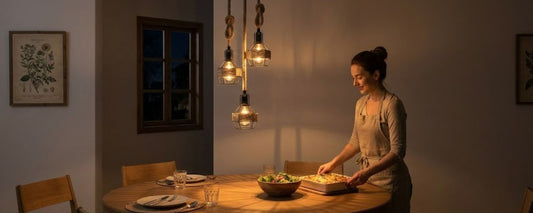
For pendant lights, sizing works a little differently, since there's no fixed base to measure against — it's about the room and the hanging height instead. As a rough guide, a pendant shade should be 2–3 inches narrower than the surface it hangs over (a table or an island) on each side, and hung so the bottom sits 28–36 inches above the surface below it.
Rule of thumb: when in doubt between two shade sizes, size up. An oversized shade reads as a design choice; an undersized one reads as a mismatch.
| Lamp Type | Shade Height Rule | Shade Width/Diameter Rule |
|---|---|---|
| Table Lamp | ≈ 75% of base height | ≈ 2× base width |
| Floor Lamp | ≈ ⅓ of total lamp height | Wide enough to clear the widest point of the base |
| Pendant Light | Depends on ceiling height & hang length | 2–3 in. narrower than table/island on each side |
Rule 3: Match the Fitting Type
Shape and proportion get the look right — but the shade also has to physically attach to your lamp. This comes down to the fitter, which is the hardware that connects the shade to the base or socket. Get this wrong and even a perfectly sized shade won't sit correctly, or won't fit at all.
- Spider fitting: the most common type on table and floor lamps. A ring with spokes sits on top of the harp (the wire loop around the bulb) and is held in place with a finial. If your lamp has a harp, you need a spider-fitted shade.
- Clip-on fitting: the shade clips directly onto the bulb, with no harp required. Common on smaller accent lamps and some chandelier-style fixtures.
- UNO fitting: the shade has a threaded ring that screws onto the socket itself, sitting the shade directly on top of the bulb assembly. Common on hanging fixtures and some vintage lamps that don't use a harp.
If you're replacing a shade and keeping the same base, check the current shade's fitting type before you shop — it's the fastest way to guarantee compatibility. If you're pairing a shade with a completely different or new base, check the base's harp and socket setup first, since not every base includes a harp by default.
Shop Easy-Fit Replacement Shades
If you're not sure which fitting your lamp uses, easy-fit shades are the lowest-risk option — they're designed to work with standard E26 and E27 fittings without needing to match a specific harp size.
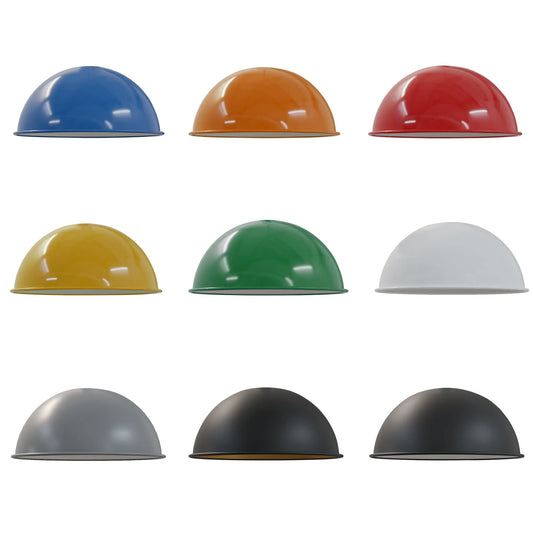

Browse the full range in our Lamp Shades collection, or check compatible bulbs in our Bulbs collection once your shade and base are paired.
Color, Material, and Finishing Touches
Once shape, proportion, and fitting are settled, color and material are where you personalize the match.
- Fabric shades (cotton, linen) give a warm, diffused glow — good for living rooms and bedrooms.
- Metal shades direct light more than they diffuse it, giving a brighter, more focused beam — a natural fit for industrial or farmhouse styles.
- Paper shades diffuse light gently and suit minimalist spaces.
- Natural fiber shades (jute, rattan) add texture and work well in relaxed, organic interiors.
Color-wise, white and cream are the safest choices and will look right with almost any base. Black shades add drama but pair best with a brighter bulb to avoid making a small room feel darker. If your base has a metallic finish — brass, copper, matte black — picking up that same tone in the shade's interior lining (many metal shades are finished in gold or white inside) ties the whole lamp together.
Common Mistakes to Avoid
- Guessing instead of measuring. A tape measure takes thirty seconds and prevents a return shipment.
- Buying a shade that's too tall for the harp. Always check that the shade fully covers the socket and any visible wiring — if the bulb or hardware is exposed below the shade, it's the wrong height.
- Ignoring the fitting type. Size and shape are irrelevant if the shade physically can't attach to your lamp.
- Choosing shape purely on trend. A shade that doesn't echo the base's silhouette will look mismatched no matter how popular the shape is right now.
Final Thoughts
Matching a lamp shade to a lamp base isn't about finding the "perfect" shade in isolation — it's about finding the shade that completes the base you already have. Once you've measured the base, identified its shape, and confirmed the fitting type, you've done the hard part. Everything after that — color, material, texture — is just styling, and there's no wrong answer as long as the proportions and fitting are right.
Frequently Asked Questions
How do I know what size lamp shade I need?
Measure your lamp base's height and width, then apply the sizing rules: for table lamps, the shade diameter should be about twice the base width, and the shade height about 75% of the base height. For floor lamps, aim for a shade height around one-third of the lamp's total height.
Can you put any lamp shade on any lamp?
Not quite — the shade's fitting type (spider, clip-on, or UNO) has to match how your lamp is set up. A shade with a spider fitting needs a harp to sit on, while clip-on and UNO shades attach directly to the bulb or socket without one.
What shape lamp shade goes with a round lamp base?
Round or cylindrical bases pair best with round, drum, or bell-shaped shades, since matching the silhouette keeps the lamp visually balanced.
Will a black lamp shade make a room too dark?
Not necessarily. A black shade blocks more light from spreading sideways, but pairing it with a brighter bulb balances this out, so it won't leave the room noticeably dimmer.
How do I find the fitting type on my current lamp shade?
Check the top of the shade: a ring with spokes resting on a harp and secured by a finial is a spider fitting, a shade that clips onto the bulb itself is clip-on, and a shade with a threaded ring that screws onto the socket is UNO.
Etiquetas:
Anterior
DIY Guide: Wiring a New Light Fixture Safely
Próximo
5 Best Plug-In Pendant Lights for Renters & Small Spaces
Artículos relacionados
DIY Guide: Wiring a New Light Fixture Safely
Aug 19 2026